
You know, how they put the cheap metal axles in little plastic casters that go under Chinesium cabinets and such.
The rivets in cheap tools that let things move and spin.
If you have ever seen an Emergency Brake assembly with a foot pedal on it from a car from the 60’s to the early 2000’s, the part that you push down on swivels on a big rivet.
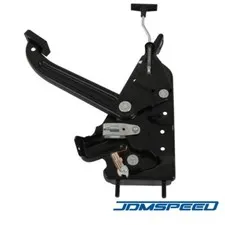
I always wondered how they made those and now I know. I ran across it earlier today and the process is called Orbital Riveting.
Orbital riveting is a low-force, noiseless cold-forming process that joins components by using a peen tool held at a fixed angle (typically 3° to 6°) to gradually deform a rivet.
Unlike impact riveting, the tool rotates off-center, maintaining a sweeping line of contact that progressively kneads the material into a desired shape with significantly reduced axial force.
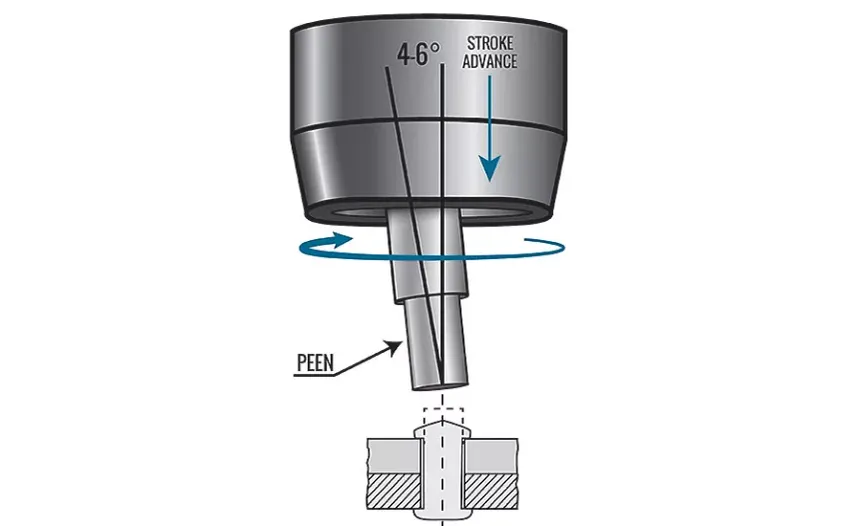
Of course there is a special machine with special bits that go in it they call Peens.
They can have different contours on the ends for specific types of finishes.
They can also control how far the end of the rivet expands and sticks out too.
That’s how they can allow parts to move and not fall off.
Here is the difference between Press Riveting and Orbital Riveting.
Just thought I would share, I’ve been turning wrenches for 45 years now and had never heard of it.
My ex-wife used the same process to remove all my money from my wallet.
We make door handles, and one of our fixing options is this. One has to adjust the dimensions of the parts, considering the material properties, to get a sweet spot. Over-peen the rivet head and it will crack radially, ruining the finish, and eventually fail; under-peen it, and the connection will become loose. The mindset you need to work like this is different from part-swappers that seem to make up most mechanics nowadays. We start with raw materials and must deliver a durable and pretty product. It is easier when you have massive batch runs…a certain proportion of product will be unusable during adjustment. Five wasted parts is a big thing in a run of one hundred, less so when one makes thousands. If you are making only one Thing, you have to know what you are doing.
Thanks. That was enlightening.
The thing is, is that the “axle” is actually soft metal (AISI 1008, 30,000 psi yield) that works in situations where the rotation on the “axle” is a small degree arc and relatively slow. The process is actually cold work forming at a specific “sweet spot” deforming rate. As noted to fast and the material doesn’t cold form but “shears” apart from the strain rate being too great. Too slow and the head doesn’t form correctly and it results in a sloppy head. Now the secret is the clearance between the hole and the shaft and the thickness of the material being joined. Variances exist in the manufacturing of the raw material the parts are made from of a few thousands (+/- .005″). These effect joint integrity more than ambient temperature effect. Controlling for these variables is a product of work between procurement, engineering and manufacturing.
35 year engineer here.
Spin
“sloppy head” You say that like it’s a bad thing.
Just kidding, my pop is an engineer and my son is a mechanic so this is exactly the kind of thing we’re all interested in. Thanks to you and Phil for the info.
Meh, just use a ball peen,,,,,,,,hammer.
for the last 59 years I have orbital peened my rivets with a ball peen hammer. When they made my cars in the 30s and 50s, a life expectancy of 100 years was not a goal. My 1926 Ford model is in excellent condition and has made it to 100
I’ve heard the term, and seen parts peened in, but never knew what type of machine they used.
Thanks, Phil, I learned something new!
Interesting information. I’d wondered about that in passing now and again when working on one of my vehicles, but never deeply enough to look it up.
We do both cold and hot forming, cold on 300 series stainless, hot for titanium. Assembling turbine buckets to the shroud band, our machine is made by Taumel.