14 thoughts on “Spaghetti connections, or, how we ever survived the birth of computing.”
So? I dealt with this every day. Nuttin’ new there.
Thems were the good ol’ days, my friends.
Actually, it made customizing your computer setup to your specific wants and needs easier. Today’s computers have all kinds of junk added to them that the geeks want for their ‘dream machine,’ but the average user doesn’t use. They have completely lost sight of KISS.
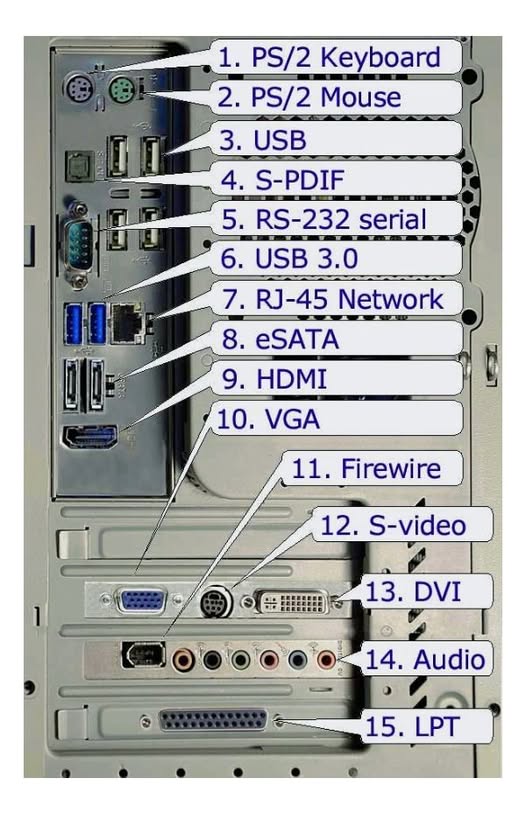
#5 I thought the 9-pin male was RS-485 and the 23-pin male was RS-232. I used to have to crimp and make my own connectors 40 years ago.
They took the 23-pin and figured out that mostly only 9 pins would work Just fine. The parallel port went the way of the dodo.. Most laptop connections are notably limited, with USB 2.0 and 3.0, SCSI, HDMI, and sometimes firewire. SPDIF is just fine for high-end audio but is hardly used. SATA is hanging around, but S-video and DVI really went away with advent of HDMI. A LOT if the cheap bastich laptop makers (Chromebook!!) don’t even have HDMI.
And, for some Godforsaken reason VGA lves on…
i just find something that fits and hope for the best.
Its missing a SCSI card and and an ST fiber ethernet card. Before I look it up, RS-485 is long-distance serial (yep, it also does multi-drop which I never did.) If I remember correctly it used a floating ground? or some such nonsense…
The cable shield had to be one-end grounded when running LONG wires. I once pushed RS-232 over 900 feet at 9600 in an extremely electrically noisy environment.
My first PC was a hand-me-down from my younger brother. He is the alpha-geek of the family and programs for a living.
It had a Cyrix MII-333GP processor, a 256MB HDD, an nVidia RIVA 128 video card, running Windows 95.
Talk about a turtle. Several minute BOOT times.
A small ass CRT monitor being fed over a VGA.
NO USB, at all. One serial and one parallel port.
Sound was carried out on a 8 bit Creative Labs, Sound Blaster card.
Of course, it was fed by a 56kbs modem – of which I was only getting around 12kbs.
Now your average phone can blow it out of the water
Leigh
Whitehall, NY
My first PC was a company purchase – an original IBM PC with an 8088 CPU and a whopping 1MB of RAM, Hercules graphics (720 x 348 resolution), and a 10 MB hard drive. It cost about $5000. I ran DesqView for multi-tasking, after adding more memory. The [not] good old days of fiddling with expanded memory.
My first one had less ram and memory but both size floppies so I was in tall cotton with windows 3.1 and 9600 baud modem
Buncha’ new kids and their toys. It’s missing the AUI interface that allowed 10Base-T, ThickNet or ThinNet (10Base-2 or 10Base-5) “dongles”. Frozen Yellow Garden Hose mean anything?
My first machines were in high school: one was an ADM-3A dumb terminal with an acoustic coupler, the other an SWTPC kit. The ADM was used to dial into a PDP-8 at Vanderbilt University across the street. The SWTPC had an external cassette player used to load the OS and Basic into 4K of RAM.
Then there was the Sinclair ZX-81, several mainframe accounts, then finally an original Apple Macintosh with 128k RAM and 400k 3-1/2” floppy drive.
Good times!
I have FINALLY met a fellow traveler with Sinclair ZX-80 experience!
I can die happy now, I am not alone…
(Still have several OLD machines left in my collection!)
That shattered my delusions, I only thought there was only one of you Igor….

So? I dealt with this every day. Nuttin’ new there.
Thems were the good ol’ days, my friends.
Actually, it made customizing your computer setup to your specific wants and needs easier. Today’s computers have all kinds of junk added to them that the geeks want for their ‘dream machine,’ but the average user doesn’t use. They have completely lost sight of KISS.
#5 I thought the 9-pin male was RS-485 and the 23-pin male was RS-232. I used to have to crimp and make my own connectors 40 years ago.
They took the 23-pin and figured out that mostly only 9 pins would work Just fine. The parallel port went the way of the dodo.. Most laptop connections are notably limited, with USB 2.0 and 3.0, SCSI, HDMI, and sometimes firewire. SPDIF is just fine for high-end audio but is hardly used. SATA is hanging around, but S-video and DVI really went away with advent of HDMI. A LOT if the cheap bastich laptop makers (Chromebook!!) don’t even have HDMI.
And, for some Godforsaken reason VGA lves on…
i just find something that fits and hope for the best.
Its missing a SCSI card and and an ST fiber ethernet card. Before I look it up, RS-485 is long-distance serial (yep, it also does multi-drop which I never did.) If I remember correctly it used a floating ground? or some such nonsense…
The cable shield had to be one-end grounded when running LONG wires. I once pushed RS-232 over 900 feet at 9600 in an extremely electrically noisy environment.
My first PC was a hand-me-down from my younger brother. He is the alpha-geek of the family and programs for a living.
It had a Cyrix MII-333GP processor, a 256MB HDD, an nVidia RIVA 128 video card, running Windows 95.
Talk about a turtle. Several minute BOOT times.
A small ass CRT monitor being fed over a VGA.
NO USB, at all. One serial and one parallel port.
Sound was carried out on a 8 bit Creative Labs, Sound Blaster card.
Of course, it was fed by a 56kbs modem – of which I was only getting around 12kbs.
Now your average phone can blow it out of the water
Leigh
Whitehall, NY
My first PC was a company purchase – an original IBM PC with an 8088 CPU and a whopping 1MB of RAM, Hercules graphics (720 x 348 resolution), and a 10 MB hard drive. It cost about $5000. I ran DesqView for multi-tasking, after adding more memory. The [not] good old days of fiddling with expanded memory.
My first one had less ram and memory but both size floppies so I was in tall cotton with windows 3.1 and 9600 baud modem
Buncha’ new kids and their toys. It’s missing the AUI interface that allowed 10Base-T, ThickNet or ThinNet (10Base-2 or 10Base-5) “dongles”. Frozen Yellow Garden Hose mean anything?
My first machines were in high school: one was an ADM-3A dumb terminal with an acoustic coupler, the other an SWTPC kit. The ADM was used to dial into a PDP-8 at Vanderbilt University across the street. The SWTPC had an external cassette player used to load the OS and Basic into 4K of RAM.
Then there was the Sinclair ZX-81, several mainframe accounts, then finally an original Apple Macintosh with 128k RAM and 400k 3-1/2” floppy drive.
Good times!
I have FINALLY met a fellow traveler with Sinclair ZX-80 experience!
I can die happy now, I am not alone…
(Still have several OLD machines left in my collection!)
That shattered my delusions, I only thought there was only one of you Igor….
No AT kybd connector or twin-ax?